AI Receptionist for Salons: What to Know Before You Choose in 2026
Discover how an AI receptionist for salons automates bookings, answers calls, and syncs your CRM to stop losing clients. Read our complete 2026 salon guide.

co-founder

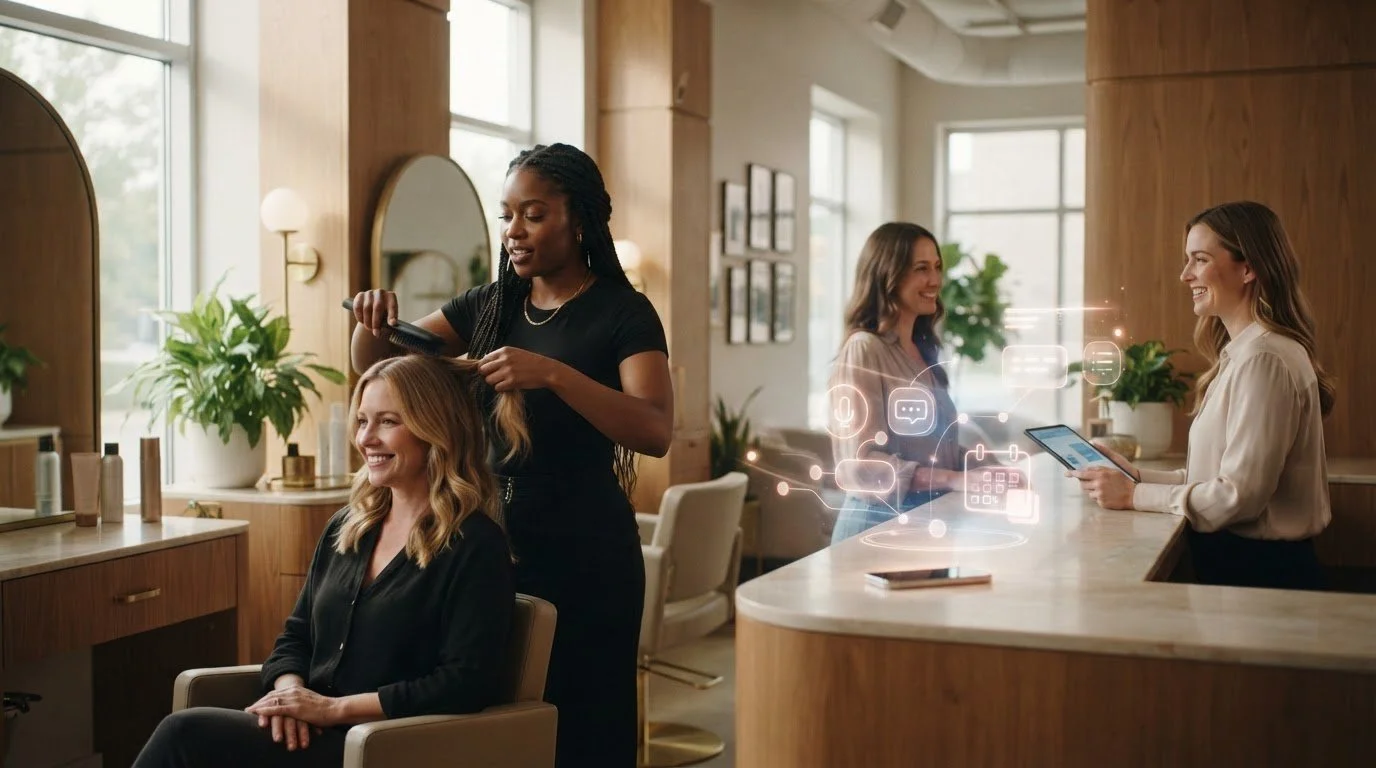
According to Zenoti’s September 2025 survey of 1,011 US salon and spa clients, 71% of salon and spa regulars have skipped booking because it was too difficult to reach someone or use the online system. When you’re mid-appointment, answering every call isn’t realistic. But leaving inquiries until later can mean a client moves on. An AI receptionist for salons can help handle routine conversations while preserving the personal touch of your service.
It’s reasonable to wonder whether AI will make client communication feel impersonal or add another system to manage. A useful setup should support your team, not replace the care clients value. Voice and chat assistance can respond to inquiries and support bookings, while CRM integration can help keep appointments and schedules coordinated.
This guide covers where an AI receptionist fits across the client journey, from the first question to booking and ongoing communication. You’ll learn how to assess voice and chat capabilities, booking workflows, and CRM fit, and how to decide whether an AI assistant suits your salon. The goal is to reduce repetitive communication work while keeping the client experience thoughtful.
Key Takeaways
- An AI receptionist for salons can support client communication through voice and chat, helping routine inquiries fit around a busy appointment schedule.
- Map how clients move from their first inquiry to booking and follow-up to find where automated communication could help.
- Compare options against your salon’s actual needs, including contact channels, booking workflows, CRM fit, and communication style.
- Track inquiry volume, response workload, and appointment handling before adoption so you can assess changes against your own baseline.
- AI Beauty Bot brings voice, chat, salon bookings, inquiries, and CRM schedule synchronization into a coordinated reception workflow.
Table of Contents
- Why salons consider an AI receptionist when every appointment matters
- How a salon AI receptionist supports the client journey
- How to assess whether an AI receptionist fits your salon
- How salons can measure value without relying on generic AI claims
- How AI Beauty Bot fits into a salon’s reception workflow
Why salons consider an AI receptionist when every appointment matters
A call comes in halfway through a colour consultation. Your hands are busy, your client is waiting, and nobody else is free to answer. The phone stops ringing. Will that person call back, send a message, or move on?
That moment isn’t a failure of service. It’s the reality of a salon where client care takes attention. But when calls and messages compete with treatments, checkout, and conversations, routine inquiries can wait until there’s a pause. That creates friction for clients trying to learn about a service or arrange an appointment, even if they aren’t ready to book right away.
What does an AI receptionist for salons actually do?
An AI receptionist is software that handles routine salon interactions through voice and chat. An online booking page, by contrast, is a self-service calendar where clients select an appointment. The difference matters: a calendar provides a booking route, while a receptionist can also respond to inquiries through conversation.
An AI receptionist for salons can support routine booking requests and answer questions through voice and chat. Artificial intelligence is the technology behind this kind of software; What is Artificial Intelligence? offers a broad introduction to the field. In salon use, the practical point is simpler: the assistant helps manage communication, not hair, skin, or beauty services.
For example, a client might ask about availability while you’re completing checkout. A voice or chat assistant gives them another way to make an inquiry or request a booking. A website calendar lets them choose from the options it displays, but it doesn’t have a conversation with someone who has a question.
Why salon communication gets interrupted
Salon work is hands-on. During a consultation, you’re listening closely and discussing what the client wants. During a treatment, stepping away to answer the phone can interrupt the service. At checkout, a call may arrive while you’re confirming the next appointment or taking payment. Messages often pile up in those same gaps.
After closing, a new inquiry may arrive while the team is away. Unless someone responds through an available communication process, it can wait until staff return. Not every delayed message becomes a missed booking, but the client still has to wait, and staff may come back to a queue of questions to sort through.
The useful question isn’t whether a salon should answer every call personally. It’s which routine interactions can be handled without pulling staff away from the client in front of them. A voice and chat assistant can take on some of that communication work, while the salon team stays focused on consultations, treatments, and the judgment personal service requires.
How a salon AI receptionist supports the client journey
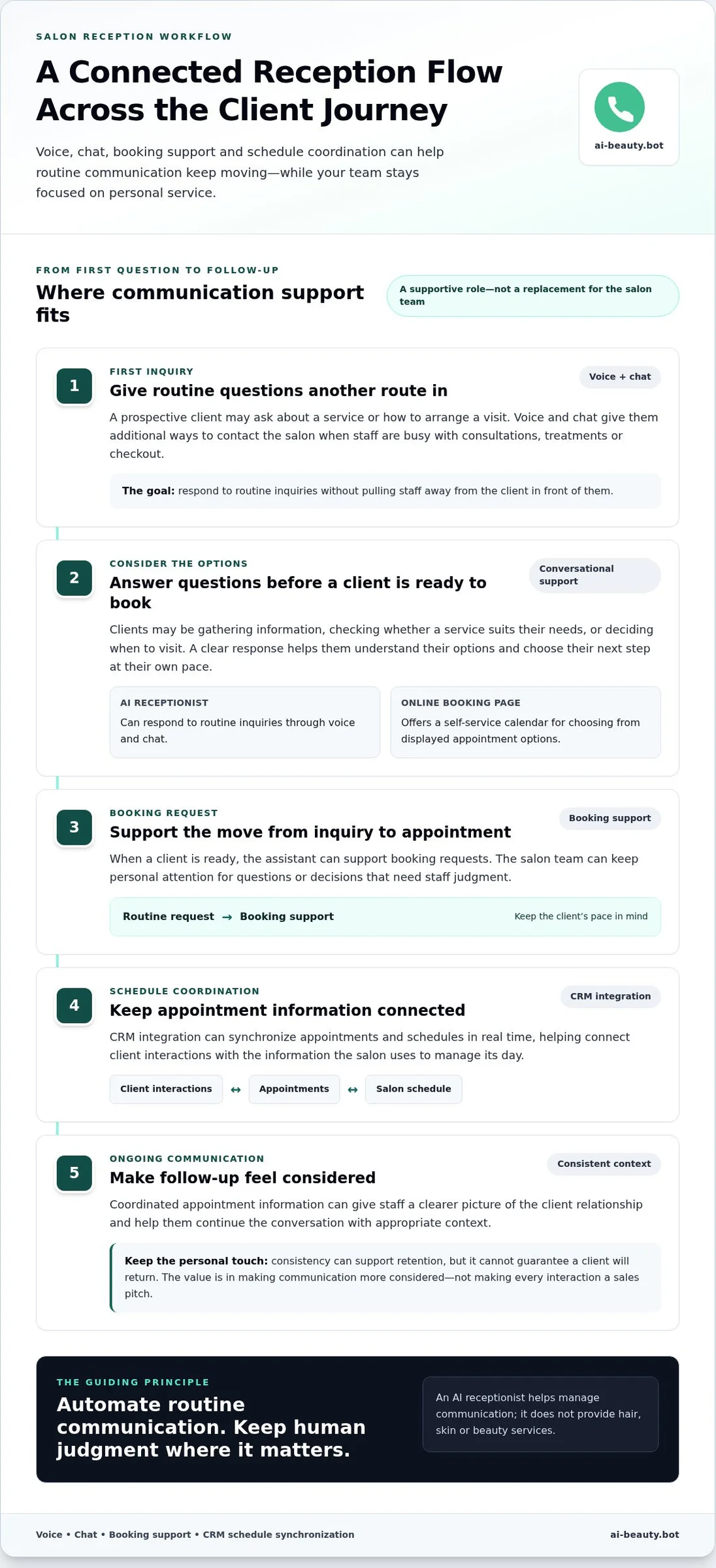
A client’s relationship with a salon doesn’t begin and end with a phone call. They may first ask about a service, then decide whether to book, attend their appointment, and later get back in touch. A voice and chat assistant can support communication at several of these points, helping the salon respond consistently while the team focuses on the client in front of them.
Connected client communication matters because a smooth booking is only one part of an experience that can shape whether someone feels comfortable returning. A helpful first response sets expectations. Coordinated appointment information helps the team stay on the same page. Ongoing, consistent communication gives the salon another way to stay connected without making every interaction feel like a sales pitch.
From first inquiry to appointment
A prospective client may want to know whether a salon offers a particular service or how to arrange a visit before choosing an appointment. They might call while travelling or send a chat inquiry while comparing options. If the first question goes unanswered, they still need to decide what to do next. A voice and chat assistant gives them additional ways to contact the salon and ask routine questions.
Consistency matters across those channels. Supporting inquiries by voice or chat can help people with different communication habits get routine answers without staff having to repeat each one from scratch. When a client is ready to book, the assistant can support booking requests. The salon team can focus its personal attention on questions or decisions that need staff judgment.
This isn’t about pushing every inquiry toward an appointment. A client may be gathering information, checking whether a service suits their needs, or deciding when to visit. A clear response at that early stage helps them understand their options and choose their next step at their own pace.
Keeping salon communication connected
Communication becomes more useful when appointment details and the salon schedule stay aligned. CRM integration can synchronize appointments and schedules in real time, helping connect client interactions with the information the salon uses to manage its day. A shared view can support more coordinated appointment handling across the team.
That connection also gives the salon a practical foundation for ongoing client communication. When appointment information is better coordinated, staff can work from a clearer picture of the client relationship and continue the conversation with appropriate context. Consistency can support retention, but it can’t guarantee that a client will return. The value is in making communication more considered, not assuming software can create a relationship on its own.
To see how that connection works in practice, explore AI Beauty Bot’s voice and chat assistant, designed to handle salon inquiries and support bookings while integrating with salon CRMs for real-time appointment and schedule synchronization.
How to assess whether an AI receptionist fits your salon
Start with the pressure points in your actual day, not a feature list. An AI receptionist for salons is worth considering when it addresses a real communication bottleneck and fits the way your team handles inquiries and appointments.
Assess workflow fit before counting software features. A tool can offer plenty of options and still be a poor match if it doesn’t support the channels clients use or keep appointment information coordinated.
Match the assistant to your communication workflow
For a short period, note when calls and chats come in, who responds, and which questions interrupt services most often. Are clients asking about bookings, services, or other salon information? Does one team member handle replies, or does responsibility shift between staff? These details show where routine communication takes time and where an assistant could help.
Then compare the key parts of your workflow:
Inquiry channels: Essential: support for the voice or chat channels clients already use. Optional: adding a channel your clients rarely choose.
Booking needs: Essential: support for the booking requests that currently create the most work. Optional: extra booking-related functions that don’t solve a current problem.
CRM fit: Essential: appointment and schedule information that stays aligned with the salon’s existing workflow. Optional: handling information or processes your team doesn’t rely on.
Communication style: Essential: responses that match the clear, welcoming way your salon speaks to clients. Optional: customization that looks appealing but doesn’t make interactions more useful.
This isn’t a universal scorecard. If phone inquiries often interrupt treatments, make voice support a priority. If clients already contact you through chat, assess that channel just as closely. If clients use both, consider both when comparing options.
Check appointment and CRM alignment
Next, trace what happens after a client makes an inquiry. Where does the booking information go? Which schedule do staff use to see appointments? What client details need to stay connected to that appointment? Write down the records your team depends on, then compare them with the information the assistant needs to support your booking workflow.
Real-time synchronization between a salon CRM, appointments, and schedules can help keep information aligned. This matters when staff rely on a shared view to coordinate the day. If appointment details sit in disconnected places, adding another communication channel may create extra steps instead of reducing them. Assess not only whether systems connect, but whether the resulting workflow is clear for the people using it.
Separate must-haves from nice-to-haves before comparing options. Essential requirements usually connect to a current bottleneck: the channels clients use, the booking requests staff handle, and the records needed to manage appointments. Optional conveniences can wait until the core process is clear. For more detail, map how CRM integration supports appointment coordination as part of the workflow.
How salons can measure value without relying on generic AI claims
Judge an AI receptionist against your salon’s starting point, not someone else’s headline result. Before adopting one, record what’s happening now: how many inquiries come in, how much staff time routine responses take, and how appointment information is handled. Keep the measures simple enough to review alongside the other demands of running a salon.
Choose measures that reflect salon priorities
Pick indicators that connect directly to the communication problem you want to solve. If staff are often pulled away from clients to respond, track time spent on routine inquiries. If appointment details are difficult to coordinate, observe whether schedules and booking records stay aligned. The aim is to see what changes in your workflow, not to chase a number that may not reflect your priorities.
- Inquiry handling: Record incoming inquiries by channel and note which ones receive a response through the assistant or need staff attention.
- Staff workload: Estimate time spent answering routine questions and handling booking requests, using the same method before and after adoption.
- Appointment coordination: Note whether appointments and schedules remain synchronized, and record recurring mismatches that require staff to step in.
Separate these operational indicators from broader business outcomes. Appointment volume, repeat visits, and revenue can be affected by seasonality, promotions, staffing, service demand, and other changes. They may be worth reviewing, but they can’t show on their own that an assistant caused a particular result. Don’t treat a vendor’s conversion or upsell figures as a forecast for your salon.
Review results and improve the workflow
After adoption, compare the measures with your baseline over a consistent period. Use the same definitions and tracking method so the comparison is useful. Note changes in staffing, promotions, or busy periods that could affect the numbers. Look for practical signals: are fewer routine questions interrupting services, are appointment details staying coordinated, and which inquiries still need a person to respond?
Use what you find to refine the process. If the same client question keeps needing staff input, review whether the assistant’s response can be clearer. If appointment information doesn’t stay aligned, examine where the handoff between communication and scheduling breaks down. Small workflow adjustments can make the system more useful without assuming every task should be automated.
For a grounded evaluation, define success in salon terms before you begin, then review the results with your team and adjust as needed. To put voice and chat support into that measured workflow, explore AI Beauty Bot’s salon assistant.
How AI Beauty Bot fits into a salon’s reception workflow
Once you’ve identified where communication gets stuck, consider how an assistant fits into the work your salon already does. AI Beauty Bot is a voice and chat AI assistant built for beauty salons. Beauty OS includes its own salon CRM, calendar and client records, with the AI receptionist built in. You can use Beauty OS on its own without an external CRM, or connect a supported booking platform such as Altegio, Square Appointments, Acuity Scheduling or SimplyBook.me and keep the calendar you already use. It handles client inquiries and supports bookings through automated interactions, giving routine communication a place in the reception workflow while your team focuses on in-person service.
A salon-focused voice and chat assistant
Clients don’t all contact a salon in the same way. Some prefer to call; others use chat. AI Beauty Bot supports both, bringing those interactions into a workflow designed for salon bookings and inquiries. That can help when staff are busy with appointments and can’t turn their attention to every routine question. The assistant supports salon operations, while people remain responsible for the services and personal care clients come in for.
For a salon considering an AI receptionist for salons, the practical question is which communication tasks it can take on and how those tasks connect with the team’s day. Voice and chat support give clients more than one way to make contact. Automated inquiry handling can also help staff spend less time repeating routine responses, without implying that every client conversation should be automated.
Connected appointments and consistent client communication
AI Beauty Bot integrates with salon CRMs to synchronize appointments and schedules in real time. That connection ties reception interactions to the appointment information the salon uses to coordinate its work. Rather than treating the assistant as a separate answer channel, consider how its booking support and CRM integration fit into the existing flow of client communication and appointment management.
Consistency matters after the first inquiry, too. Clear, ongoing communication can support a salon’s client-retention efforts by helping the business stay connected with clients over time. It doesn’t guarantee repeat visits. It gives the salon an operational way to support communication as part of the wider client relationship, alongside the personal service delivered by the team.
Before introducing an assistant, connect its role to the bottleneck you identified. If routine inquiries interrupt appointments, focus on how voice and chat support could fit around those interactions. If coordinating appointment information is the strain, consider how real-time CRM synchronization could support the schedule. Keep the goal specific: a more coordinated reception workflow, not automation for its own sake.
AI Beauty Bot brings voice, chat, booking support, client inquiries, and CRM synchronization together for beauty salons. Explore AI Beauty Bot to see how it could fit into your salon’s reception workflow.
Make your next step a practical one
You don’t need to redesign your whole reception process at once. Choose one recurring point of friction, then decide what a smoother handoff between automation and your team would look like. Which conversations can be handled routinely? Which need a personal response? A clear answer helps keep the client experience warm while making the workflow easier to manage.
The right AI receptionist for salons should fit the way your business serves people, not push your team into an awkward process. Treat the decision as an opportunity to shape communication around your salon’s priorities and the attention your clients deserve.
Explore AI Beauty Bot for your salon and see how a voice and chat assistant could support your reception workflow. Start with one practical change.
Frequently Asked Questions
Is an AI receptionist the same as online booking?
No. Online booking lets clients choose an appointment through a calendar, while an AI receptionist for salons handles conversations through voice or chat and can support booking-related questions. Someone unsure which service to select, for example, may need information before they’re ready to use a calendar. Consider where clients need a conversation and where self-service works best. The two can complement each other, but they serve different parts of the booking experience.
Can an AI receptionist work with an existing salon CRM?
Yes. AI Beauty Bot integrates with salon CRMs to synchronize appointments and schedules in real time. As you assess CRM fit, consider how your salon records bookings and which schedule staff rely on during the day. If your team uses a shared appointment view to coordinate work, keeping that information aligned is especially relevant. Include those workflow needs in your evaluation rather than judging an assistant only by how it answers inquiries.
What happens when a client asks an AI receptionist an unusual question?
The response depends on the information available to the assistant and the process your salon sets for questions that need personal judgment. Decide which questions have clear, approved answers, such as how your salon describes a service, and which should be handled by a staff member. Keep the assistant’s information accurate and focused. For sensitive or unusual requests, a clear staff response process helps prevent clients from receiving an answer that doesn’t fit their situation.
How much does an AI receptionist for salons cost?
AI Beauty Bot provides its receptionist and retention software through a recurring subscription. When evaluating the cost, identify the communication work you want to support and the CRM workflow involved, then compare those needs with the subscription terms. Broad market averages may not reflect what your salon requires, so use your own workflow priorities to guide the comparison.
Can an AI receptionist answer questions about salon services?
Yes. An AI receptionist can handle client inquiries, including questions about salon services, when the relevant information is available to it. Keep service descriptions clear and consistent so the assistant has a useful basis for its responses. For instance, review how your salon explains service names and options across its client communications. If a question calls for personal judgment or falls outside that information, staff should have a clear way to take over the conversation.
How should a salon introduce an AI receptionist to clients?
Explain it plainly. Let clients know which channels the assistant can handle and how to reach the salon through them. Keep that message consistent wherever clients contact you, and make sure the assistant’s information reflects your actual services and booking process. After introducing it, gather feedback from staff and clients. If people seem unsure where to go next or what the assistant can help with, adjust the explanation or workflow to make the experience clearer.