AI Assistant for Beauty Salons: What It Can Handle
Discover how an AI assistant for beauty salons handles bookings, answers routine calls, and syncs your CRM so you can focus on the clients in your chair.

co-founder

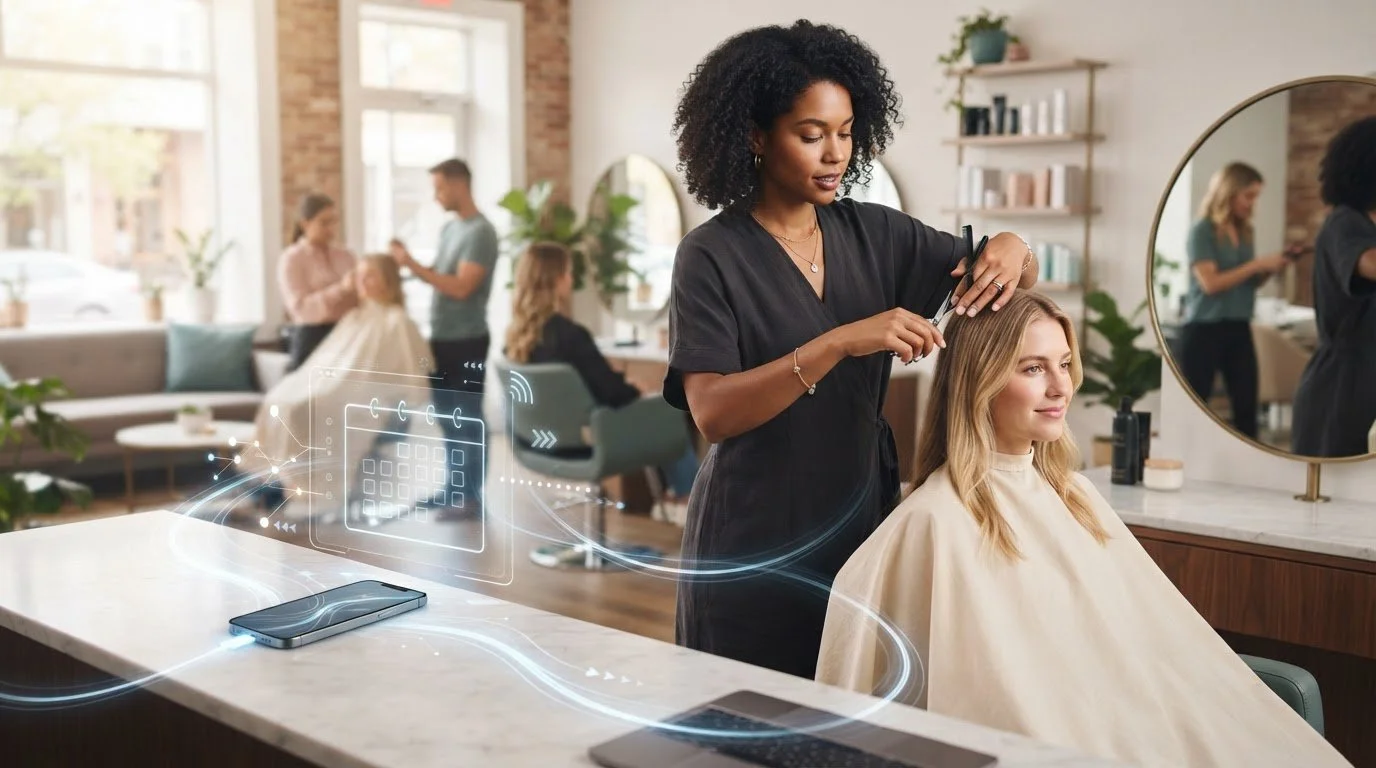
Your hands are full with a client, and the phone rings again. A message asks about availability. Another client wants to book. An AI assistant for beauty salons can handle routine conversations and booking requests, so every inquiry does not have to interrupt the service happening in front of you.
Unanswered calls and messages can mean missed chances to fill your schedule. The right support does not replace the personal care clients come to you for. It keeps everyday communication moving while you focus on the person in your chair.
This article explains what a salon AI assistant can handle, how voice and chat support bookings and CRM activity, and where your team’s judgment still matters. You’ll find practical examples for routine questions, appointment requests, schedule synchronization, and follow-up that supports client retention. You’ll also see when a staff member should step in, especially when a client has a sensitive concern or needs personalized advice.
Key Takeaways
- An AI assistant for beauty salons handles routine client conversations, helping reduce interruptions during hands-on appointments.
- Voice and chat give clients different ways to ask questions and start booking interactions.
- Connecting inquiries and booking activity with salon CRM records helps keep appointments and schedules synchronized.
- Consistent routine communication can support client retention, while personalized advice still calls for staff knowledge.
- Separate repeatable front-desk tasks from situations where a team member’s judgment and personal service matter.
Table of Contents
- What an AI Assistant for Beauty Salons Does in a Busy Workday
- How a Salon AI Assistant Connects Client Inquiries to Bookings
- How AI Supports Salon Client Communication Beyond the First Inquiry
- Which Salon Tasks Should an AI Assistant Handle, and Which Need Staff?
- How AI Beauty Bot Fits Into a Beauty Salon’s Front Desk
What an AI Assistant for Beauty Salons Does in a Busy Workday
A client is in the chair. The phone rings. A message asks about a service, and someone else wants to know how to book. Each question may be simple on its own, but together they pull attention away from appointments. A missed call or unanswered message can also mean a booking opportunity lost.
An AI salon assistant handles routine client conversations through voice and chat, supporting inquiries, booking requests, and consistent communication. It responds using information and processes the salon has defined, while staff focus on clients and decisions that call for professional judgment. A chat assistant is one way to exchange messages with software; What is a Chatbot? offers a useful overview of the concept.
Think of it as front-desk support for conversations, not a person who can perform salon services or advise on every situation. Its practical purpose is to keep routine client communication moving without asking staff to stop hands-on work every time a familiar question comes in.
- Inquiries: Answer routine questions about salon services or general information using details the salon has provided.
- Booking requests: Support clients who want to make or discuss an appointment, following the salon’s booking process.
- Consistent communication: Maintain routine contact that supports the salon’s approach to client retention.
The dividing line is the kind of answer required. Sharing established information is repeatable. Discussing an individual client’s needs, responding to a treatment concern, or recommending a personalized approach calls for a stylist’s knowledge. The assistant can support the exchange, but it should not replace a consultation or the trust built through personal service.
Which salon tasks belong in the assistant’s day-to-day workload?
Keep the assistant’s workload clear: routine questions, booking conversations, and consistent communication. These tasks work well when the response follows information and processes the salon has defined. A client asking how to book is different from a client asking whether a particular treatment suits their circumstances. The second question needs a staff member who can understand the context and respond with care.
How does an AI assistant differ from salon software?
A CRM organizes client and appointment information; an assistant handles conversations. Beauty OS combines both in one salon system, while also supporting connections to existing booking platforms. When integrated, the assistant connects with the salon’s CRM to synchronize appointments and schedules in real time. The tools have related but distinct roles. Together, they help keep communication and records connected, while the team remains responsible for personal service, professional judgment, and the client experience.
How a Salon AI Assistant Connects Client Inquiries to Bookings
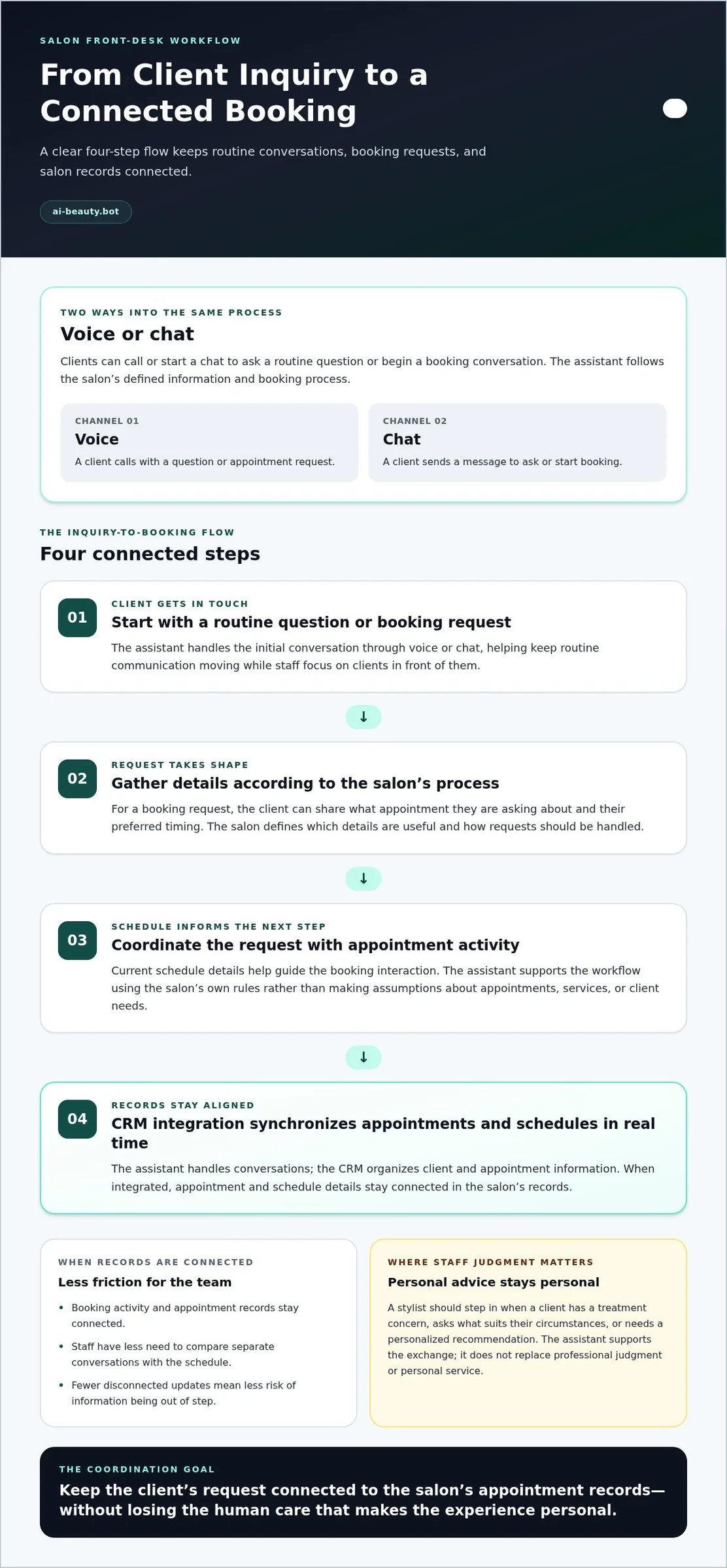
A client’s question starts a small workflow. It should not disappear into voicemail or a message thread. Whether someone calls or starts a chat, the assistant can guide the conversation toward a booking request and connect that activity with the salon’s schedule and CRM. Voice and chat are two ways into the same process.
- The client gets in touch. They ask a routine question or say they’d like to book. The assistant handles the conversation through voice or chat.
- The request takes shape. The client shares the information needed for the booking request, such as the appointment they’re asking about and their preferred timing, according to the salon’s process.
- Schedule information informs the next step. Current schedule details help coordinate the booking interaction with appointment activity.
- Records stay aligned. CRM integration synchronizes appointment and schedule information in real time, keeping related records connected.
Successful inquiry-to-booking coordination keeps a client’s request connected to the salon’s appointment records, so staff do not have to piece together separate conversations and schedule updates. That is the difference between simply answering a question and supporting a connected client journey.
What happens between a client question and an appointment?
Picture a client asking about a booking while the front desk is helping someone in person. The assistant can handle the initial exchange, gather the information needed for the request, and support the next step using the salon’s defined process. Schedule information helps coordinate the request with appointment activity. The assistant supports the workflow while following the salon’s own rules for handling bookings.
Keep the process grounded in the salon’s actual information. Staff define what details are useful and how booking requests should be handled. Clear instructions help prevent a routine exchange from becoming an assumption about a service, appointment rule, or client need. If the conversation turns to advice that depends on a stylist’s expertise, the human team remains central.
Why does CRM and appointment synchronization matter?
Without connected records, staff may need to compare a conversation with a separate schedule or manually repeat updates. That takes attention and can leave information out of step. Real-time synchronization helps keep appointment and schedule information aligned in the salon CRM, giving the team a more coherent view of booking activity. It does not remove the need for staff oversight, but it reduces the friction of disconnected records.
For salons exploring how voice and chat support can work alongside booking activity, an AI assistant for beauty salons connects client conversations with CRM and schedule synchronization as practical front-desk support.
How AI Supports Salon Client Communication Beyond the First Inquiry
A client relationship is not built through one booking exchange alone. It also depends on everyday communication that feels clear, consistent, and in keeping with how the salon treats people in person. An AI assistant supports that standard by handling routine interactions using salon-provided information, while staff give personal attention to the moments that need it.
Consistency does not mean sending more messages or making every interaction sound identical. It means clients receive clear, professional information when they have a routine question, rather than an answer that depends on who happens to be free at the front desk. This can support a salon’s existing client-retention approach, but it does not guarantee repeat visits or a particular business result.
Where can consistent salon communication help the client relationship?
Consider a client who asks about a service after an appointment. A routine exchange can provide the salon’s established information clearly and keep the conversation moving. If the client’s question shifts to what would suit their individual needs, the team can take over. This balance helps the salon maintain communication standards without making an automated response stand in for personal care.
The practical value is in reinforcing the experience the salon wants clients to have. Staff can decide which routine information the assistant should share and where a conversation needs a human touch. The assistant supports that approach across voice and chat. It does not set the salon’s service standards or create a client relationship on its own.
What should remain personal rather than automated?
Some questions have context that a standard response cannot responsibly address. A client may raise a sensitive concern, ask whether a treatment is appropriate for them, or want a stylist’s recommendation. Those conversations call for listening, professional knowledge, and an understanding of the person, so staff should handle them directly.
Personal attention matters when the right answer depends on details the client has not shared or on a stylist’s expertise. A useful division of work is simple: use an AI assistant for beauty salons to support routine communication, and keep nuanced consultations and sensitive concerns with the team. The assistant helps maintain a clear line of communication, but it should not make individualized treatment decisions.
- Routine exchange: Share salon-approved information and keep basic inquiries moving.
- Staff-led conversation: Respond to personal concerns, nuanced questions, and requests for professional recommendations.
This boundary keeps automation useful without making the salon feel impersonal. It also clarifies staff roles: the team handles judgment-heavy conversations, while routine communication follows the salon’s established approach. Consistent client contact can support retention as part of that wider relationship, with the salon’s people still at its center.
Which Salon Tasks Should an AI Assistant Handle, and Which Need Staff?
Good automation has a clear boundary. Routine, repeatable interactions can follow salon-provided information and processes. Questions that need professional judgment, personal context, or a sensitive response belong with the team. Defining that line helps an AI assistant for beauty salons support the front desk without asking it to make decisions better left to a stylist.
Use this distinction as a starting point, then adapt it to your services, policies, and workflows. A request is not automatically routine just because it arrives by phone or chat. Ask whether the response can follow information the salon has already approved, or whether it depends on understanding the client’s individual situation.
| Routine work suited to the assistant | Situations for staff judgment |
|---|---|
| Answering recurring questions using salon-provided information about services or general salon details. | Discussing whether a service or treatment is appropriate for a client’s individual needs. |
| Handling straightforward inquiries from clients who want to make a booking, according to the salon’s process. | Responding to unusual requests that fall outside the salon’s established booking process. |
| Sharing consistent, approved information across routine voice and chat conversations. | Addressing sensitive concerns, nuanced consultations, or requests for a stylist’s recommendation. |
Which interactions are a natural fit for automation?
Recurring questions are a practical place to start. A client may ask for general information about a salon service or how to make a booking. If the answer is covered by the salon’s information and policies, the assistant can handle that repeatable exchange. This keeps familiar questions from competing with in-person care, while leaving room for staff to address requests that do not fit the usual pattern.
When should a salon team take the lead?
Staff should handle exceptions, complex consultations, and questions where the right response depends on professional experience or personal context. A client raising a sensitive concern needs more than a standard answer. So does someone whose request falls outside the salon’s usual process. Decide as a team what counts as an exception and how staff will manage it, so the boundary is clear before a conversation gets complicated.
The workflow does not need to cover every possible situation. Start with common routine inquiries, then identify the kinds of questions that should stay personal. Keep the salon’s approved information and booking processes clear, and make sure staff know how they will take responsibility for conversations that need their judgment. The aim is not to automate everything. It is to reduce routine front-desk work while protecting the care and expertise clients expect.
See how AI receptionist support for your salon can help manage routine interactions within your team’s way of working.
How AI Beauty Bot Fits Into a Beauty Salon’s Front Desk
AI Beauty Bot, Inc. provides a specialized voice and chat assistant for beauty salons. It handles client interactions and inquiries, supports booking conversations, and helps keep routine communication consistent. It works alongside your salon team, not in place of the personal service clients value.
The pieces fit together in a practical way. A client starts a conversation by phone or chat. The assistant helps with routine questions and booking activity, while CRM integration synchronizes appointments and salon schedules in real time. That connection helps keep staff records aligned with activity in client conversations.
How does AI Beauty Bot support routine front-desk work?
Voice and chat give clients ways to begin routine conversations, whether they have a general question or want to book. The assistant handles those interactions while the team focuses on appointments and in-person care. CRM synchronization connects booking activity with salon records, helping coordinate appointment and schedule information. Consistent communication can support a salon’s client-retention approach, without guaranteeing repeat visits or a particular result.
To make the assistant useful, define how your salon already works before putting routine conversations into the workflow. Decide what information it should use and which situations remain the team’s responsibility. Clear boundaries help staff understand when to step in.
What should a salon clarify before using an AI assistant?
Start with conversations your team handles repeatedly. Note common client questions, the steps involved in booking requests, and the information staff rely on when responding. Then identify exceptions: questions that need a stylist’s judgment, unusual requests, or concerns that deserve a personal conversation. These boundaries should reflect your salon’s services, policies, and workflows.
Clear information matters. Keep service details and salon policies consistent, and decide which routine questions the assistant should address. Define how staff will handle cases outside those guidelines. This preparation helps routine communication stay on track without asking the assistant to guess, make individualized recommendations, or go beyond the salon’s processes.
- Map recurring inquiries: Identify the questions clients ask regularly and the salon-approved information that answers them.
- Outline booking steps: Make the salon’s booking workflow clear, including what information is relevant to a request.
- Set staff-led boundaries: Mark consultations, sensitive concerns, and unusual requests for personal attention.
With those foundations in place, AI Beauty Bot, Inc. provides focused front-desk support across voice, chat, booking interactions, and connected salon records. Explore how AI Beauty Bot, Inc. supports salon conversations to see how this approach could fit into your salon’s communication workflow.
Make Space for the Work Only Your Team Can Do
Start with one question: which routine interruption most often pulls your team away from clients? Use that as a practical way to assess how an AI assistant for beauty salons could fit into your day. Decide what a useful response looks like, what information it should rely on, and when your team should take over. A clear first step makes it easier to judge whether the support fits the way your salon works.
The goal is not to automate every exchange. It is to give routine communication a consistent place in your workflow, so your attention can stay on the service and human connection clients come in for. Your team’s experience remains central. The assistant supports the process around it.
Ready to explore front-desk support built for salon conversations? See how AI Beauty Bot, Inc. supports salon conversations and consider where it could fit into your workflow.
Frequently Asked Questions
Can an AI assistant for beauty salons handle both voice and chat?
Yes. AI Beauty Bot, Inc. offers voice and chat assistance, giving clients two ways to start a conversation with the salon. Someone with a quick question may prefer to call, while another client may find typing more convenient. Both channels support client interactions, so the salon can accommodate different communication preferences without relying on one channel for every inquiry.
Can an AI assistant book appointments for salon clients?
Yes. Booking assistance is part of the service, and appointment and schedule information synchronizes with the salon CRM in real time. A client can start a booking conversation through voice or chat, with the request handled according to the salon’s process. This connects the interaction with salon schedule information and keeps related records aligned.
Does an AI salon assistant replace a receptionist?
No. It supports front-desk work by handling client interactions and routine inquiries, but salon staff remain essential to the client experience. A team member provides personal service, handles a complex consultation, and uses professional judgment when a question depends on someone’s individual needs. The assistant is operational support, not a substitute for the human care that shapes a salon visit.
How does an AI assistant help a salon keep client information organized?
CRM integration synchronizes appointments and salon schedules in real time. That helps keep booking activity and schedule information aligned, giving the team a clearer operational picture when handling client interactions. Staff can refer to coordinated appointment information instead of piecing together separate updates. Beauty OS includes its own salon CRM, calendar and client records, with the AI receptionist built in. You can use Beauty OS on its own without an external CRM, or connect a supported booking platform such as Altegio, Square Appointments, Acuity Scheduling or SimplyBook.me and keep the calendar you already use.
Can a small beauty salon use an AI assistant?
Yes. The service is designed for beauty salons, and a small team may find routine inquiries and booking conversations especially relevant when everyone is also serving clients. An assistant can support everyday client interactions while staff focus on appointments in progress. The right use depends on the salon’s communication and booking processes, not on an assumed minimum team size.
Can an AI assistant answer questions about salon services?
Yes. It handles client inquiries using the salon’s own service information. For example, it can answer a routine question about what the salon offers when the response reflects details the business has established. A question about which service is right for a particular client is different. That calls for a stylist’s knowledge and personal understanding, not a generic answer.
How can an AI assistant support salon client retention?
AI Beauty Bot, Inc. focuses on consistent, professional communication to support a salon’s existing client relationships. When routine interactions reflect the salon’s service standards, clients can have a more organized experience across conversations. This can form part of the salon’s retention approach, but it does not guarantee repeat appointments, higher retention rates, or increased revenue. The relationship still depends on the salon’s overall service and client care.