How to Cut Salon No-Shows Without Chasing Clients All Day

co-founder

Listen to this article
English · 5:48
"I had three no-shows on Saturday. There goes my whole morning."
If you have said that out loud, you already know the maths. An empty chair is not just a lost appointment. It is the appointment you turned away to hold that slot, the product you prepped, the assistant standing idle, and the gap in a day you cannot refill at 9:05am.
Most no-show advice starts with "clients are flaky". That is not useful. Your clients are not flaky. They are busy, they forget, they book on a Sunday night and wake up on Thursday having changed their mind. The gap is not their memory. It is your confirmation process.
Here is how to close it without adding another job to your day.
No-shows are usually a confirmation gap, not a client problem
Think about the last no-show you had. When did that client last hear from you?
For most salons, the honest answer is: at the moment of booking, and then not again until they are supposed to walk in. A calendar entry is not a reminder. A booking confirmation email that lands in a promotions folder is not a reminder either.
Three things tend to be missing:
- A confirmation close to the appointment. Something within 24 hours, on the channel the client actually uses.
- A simple way to say "I need to move it". If cancelling means calling during opening hours, people just do not cancel. They ghost.
- A plan for the empty slot. A no-show at 10am with nobody on a waitlist is a no-show you paid for twice.
Fix the easy things first
Before you buy anything, tighten what you already control.
Ask for a commitment at booking. Not a deposit on every service if that does not suit your clients, but a clear "reply YES to confirm" step. A reply is a small action that makes the appointment feel real.
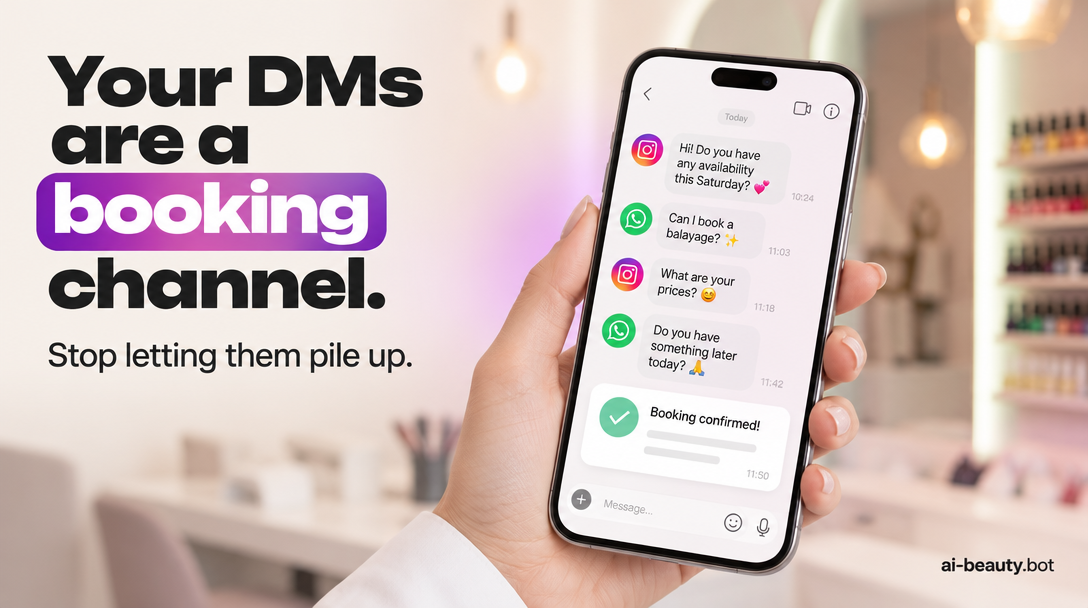
Send the reminder where your client lives. If they booked through Instagram, message them there. If they booked by phone, a WhatsApp message beats an email they will never open.
Make rescheduling a single message. "Can't make it? Reply with a new day and I'll sort it." That one line converts cancellations you would otherwise never hear about into slots you can re-sell.
Write down why people did not show. After a month you will see a pattern: a particular service, a particular time, a particular client type. Patterns are fixable. "Flaky clients" is not.
Where owners run out of hours
All of that works, and then it runs into the same wall: it needs somebody to send the messages and read the replies.
You are with a client from 10 to 11. At 11 you have a head in the basin and two WhatsApp messages waiting. At 12 you are meant to be eating something. The reminder that "should go out today" goes out at 6pm, or it does not go out at all.
That is the part that fails quietly, not because you do not care but because you are doing three jobs.
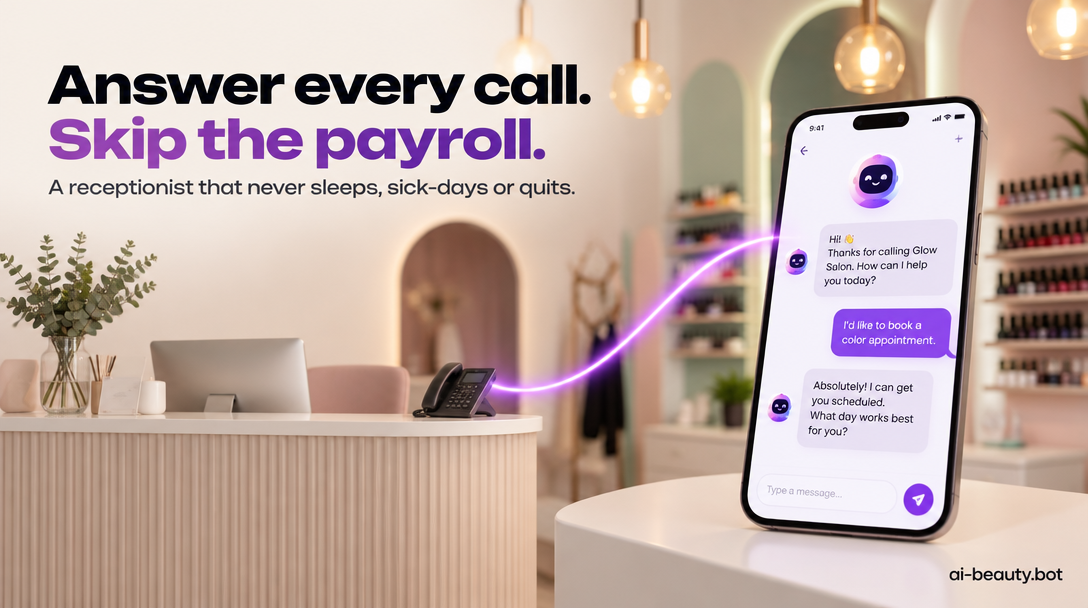
This is the specific gap an AI receptionist fills. AI Beauty Bot answers calls, WhatsApp, Instagram and other messages 24/7, sends the confirmations, handles the "can I move to Friday?" replies, and puts the change straight into your CRM. It does not need a break, and it does not need you to remember.
When an AI receptionist actually reduces no-shows
Be clear about what it does and does not do. It will not stop a client who genuinely cannot come. It will:
- Confirm consistently. Every appointment gets the same confirmation and reminder, whether you are on the floor, mid-facial, or asleep.
- Catch the wobble early. A client who wants to cancel on Wednesday can rebook on Wednesday, and you can refill the slot on Thursday. A client who goes quiet until Friday cannot.
- Answer instantly, day or night. A lot of cancellations start as a question: "what time was I in?" "do you have parking?" "can I bring my daughter?" If nobody answers for six hours, the appointment starts to feel optional.
- Keep your CRM accurate. Cancellations and changes land in Altegio, Square, Acuity or SimplyBook, so your day reflects reality instead of what you thought was booked on Monday.
Do the maths with your own numbers
Ignore any no-show statistic you read on the internet, including mine. Use your own week.
Count the no-shows and late cancellations in your last four weeks. Take an average. Multiply by your average service value. That is your monthly leak, in your money, in your town.
Then compare it to what you would spend on admin help. For most single-chair or small-team studios, the gap is uncomfortable, and it is exactly why owners end up doing reception work at 10pm instead of hiring anyone.
A simple weekly routine that sticks
You do not need a system that requires a system. Pick four things and do them every week:
- Monday: look at the week's appointments and check every one has a confirmation sent.
- Two days out: every client gets one reminder on their preferred channel.
- Same day: anyone who has not replied gets one friendly nudge, not three.
- Friday: note the no-shows and the reason, if you know it.
If that routine is realistic for your week, run it by hand. If it is already slipping, hand the messaging to something that does not get busy.
The short version
No-shows are a process problem with a people-shaped cost. Close the confirmation gap, make rescheduling a single reply, and refill the slot fast. Do it consistently, or set up something that will.
You should not have to spend your evening texting people to remind them they have an appointment.